




On this page
- Key takeaways
- What a forward deployed engineer does day to day
- Where the role came from: Palantir, then the AI companies
- Forward deployed engineer vs software engineer vs solutions engineer
- Why AI projects created a second wave of FDEs
- Vendor FDEs and independent FDEs
- When a company should bring in forward deployed engineers
- What to ask before hiring or contracting FDEs
- Frequently asked questions
- Related
Key takeaways
- A forward deployed engineer builds inside the customer's environment, on the customer's data, with the people who will own the result.
- The role started at Palantir, where FDEs deploy Foundry and AIP on site; OpenAI and other AI companies now hire FDEs to make their platforms work in customer systems.
- Vendor FDEs serve one platform. Independent FDEs serve the roadmap and choose tools that pass the test.
- A company needs FDEs when the roadmap is approved, the senior people are missing, and the work has to land in real systems rather than a demo.
- Four questions settle whether an FDE engagement is real: who owns the code, who sets the roadmap, how is it measured, and what stays when the engineer leaves.
Last updated: October 2026
A forward deployed engineer (FDE) is a software engineer who works inside a customer's organisation, systems and data to make a product or roadmap deliver results, rather than building from the vendor's side and handing over. The role was named at Palantir, spread to the AI labs, and is now offered by independent engineering firms. It matters because most enterprise AI still stalls between pilot and daily use: in ISG's 2025 survey of 400 senior AI decision makers, only 31% of enterprises had moved one of their top-three funded use cases into full production.
What a forward deployed engineer does day to day
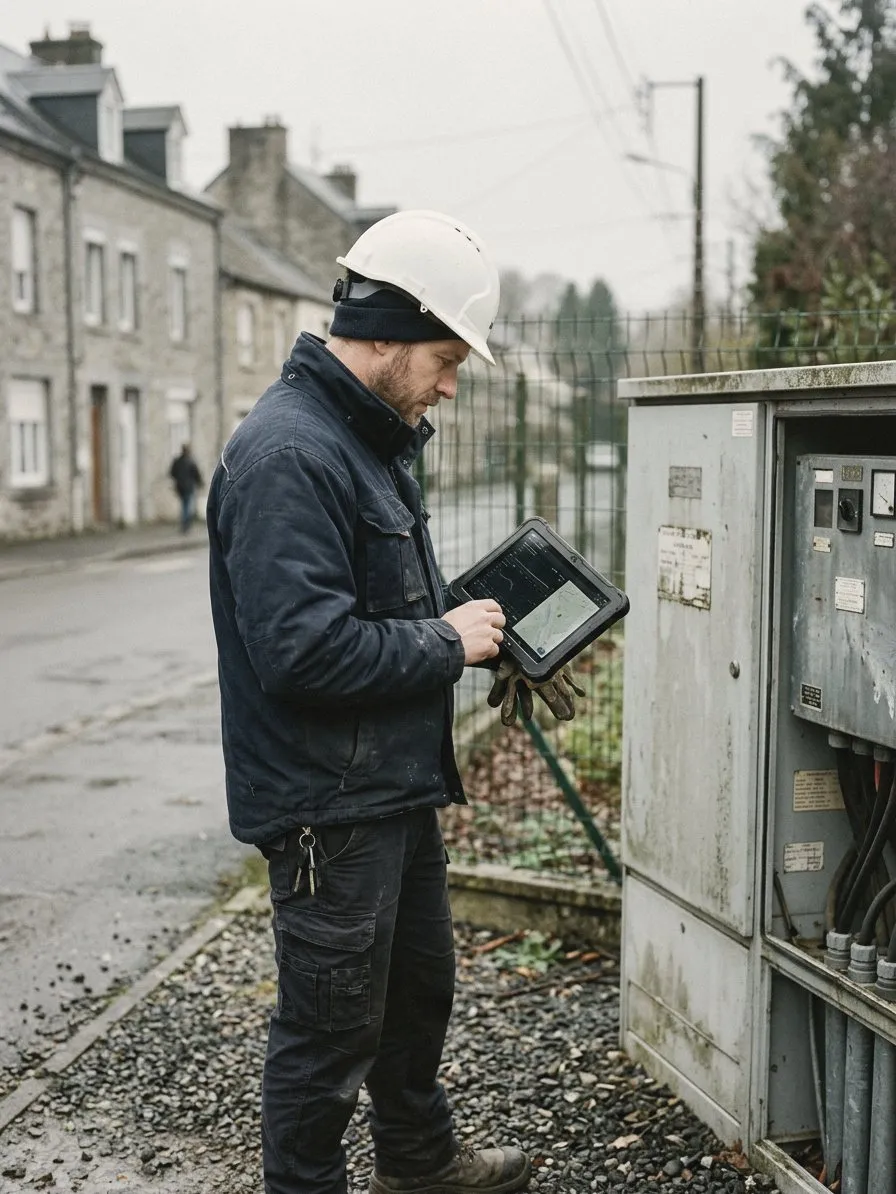
A forward deployed engineer spends the working day in the customer's repositories, data and meetings. The week starts with the customer's backlog, the code lands in the customer's CI, and the review happens with the customer's engineers. That is the whole difference from a conventional vendor engineer, who builds in the vendor's environment and ships an artefact across the fence.
Three activities fill most of the time. Discovery: reading the systems and talking to the people who run the process, to find out what the product or roadmap actually has to do here. Building: the integrations, data work, evaluations and interfaces that turn a capability into something the operation uses. Transfer: documentation, runbooks and pairing, so the customer's team can run and change the result. OpenAI's description of the role lists the same three in different words: understanding the business problem, building custom solutions on the customer's own infrastructure, and writing the scope and plan for the rollout.
Where the role came from: Palantir, then the AI companies
Palantir named the role. Its forward deployed engineers go to the customer's site to deploy Foundry and AIP, debug what breaks, and build the tooling the customer needs to adopt the platform; Palantir's own postings describe engineers embedded with customer teams who are expected to act first when something breaks, whatever the problem is. The model worked because enterprise data is messy and the people who understand it are inside the company, so the engineer has to be there too.
The second wave came with large language models. Model providers found that an API is a long way from a working system in a bank or a manufacturer, and started hiring FDEs to close that distance. The job is the same shape: live in the customer's environment, make the platform deliver, feed what is learned back to product. By 2025 the title appeared across AI companies, consultancies and independent engineering firms, with widely varying meanings behind it.
Forward deployed engineer vs software engineer vs solutions engineer
The three roles are often confused because all three write code and talk to customers. The difference is where the accountability sits.
| Forward deployed engineer | Software engineer (vendor) | Solutions engineer | |
|---|---|---|---|
| Where the work happens | Inside the customer's systems | In the vendor's codebase | Around the sale and the demo |
| Accountable for | The customer's outcome | The product | The deal and the first integration |
| Writes code that ships to | The customer's environment | The vendor's release | Prototypes and proofs of concept |
| Measured by | Adoption and the agreed business number | Product velocity and quality | Pipeline and win rate |
| Stays after go-live | Until the customer's team can run it | No | Rarely |
Why AI projects created a second wave of FDEs
AI projects fail in the gap between a model that works and a system people use. The model is rarely the problem. The data, the integrations, the evaluation and the change in how a team works are the problem, and all four live inside the customer. McKinsey's 2025 global survey of 1,993 organisations found that 88% use AI somewhere, while 7% have scaled it across the enterprise. Gartner predicts that organisations will abandon 60% of AI projects that lack AI-ready data through 2026.
A forward deployed engineer is the organisational answer to that gap. Someone has to sit where the data is, with the people who know what "correct" means for an invoice or a shift plan, and keep building until the number moves. That cannot be done from a vendor's office, and it rarely gets done by a team that is also running everything else.
Vendor FDEs and independent FDEs
A vendor's forward deployed engineer is paid to make that vendor's platform succeed. That is a legitimate job and often the right one when a company has already chosen the platform. The engineer knows the product deeply and brings the product team's attention with them.
An independent forward deployed engineer is paid to make the customer's roadmap succeed. The model, the orchestration framework and the cloud are chosen per task, by whichever option passes the evaluation at the lowest cost, and the customer can change any of them later. The trade is depth on one product for freedom across all of them. Twistag runs the independent model, with small pods in which every engineer works alongside AI agents, and publishes the way of working as the open-source FDE Field Kit.
When a company should bring in forward deployed engineers
Five situations come up again and again.
- The roadmap is approved and the senior people are missing. Hiring senior AI or platform engineers takes months, and the roadmap has a date.
- A pilot worked and the rollout has stalled. The demo convinced leadership; the integration into the ERP, the evaluation and the operating procedure did not get built.
- The internal team is at capacity running what exists. New work keeps losing to incidents and maintenance.
- The work touches data nobody outside the company understands. Pricing rules, customer histories, regulatory edge cases: the knowledge is in people's heads and the engineer has to sit next to them.
- Leadership wants the capability to stay. The engagement is meant to leave the company able to run and extend the system, which means working inside the team from day one.
What to ask before hiring or contracting FDEs
The title is used loosely, so the questions matter more than the label.
- Who owns the code, the prompts, the evaluations and the data, from the first commit?
- Who sets the roadmap, and what happens when the customer's priority changes?
- What is the number the engagement is measured against, and when is it baselined?
- Which tools and models are mandated, and which are chosen per task?
- How senior are the engineers, and who on the provider's side stays accountable?
- What stays when the engineers leave: documentation, runbooks, agents, dashboards, and time spent pairing with the internal team?
Frequently asked questions
Is a forward deployed engineer the same as a consultant?
No. A consultant typically advises or delivers a scoped project and hands it over. A forward deployed engineer builds inside the customer's systems, on the customer's backlog, and is measured on whether the result is used. Some consultancies now offer FDEs; the test is whether the engineer works in the customer's repository and is accountable for adoption.
How senior is a forward deployed engineer?
Senior, in practice. The role needs someone who can read an unfamiliar codebase, talk to a head of operations, design an integration and make judgement calls without a product manager in the room. Firms that staff the role with junior engineers are selling staff augmentation under a newer name.
What does a forward deployed engineer cost?
Vendor FDEs are usually bundled into a platform contract. Independent FDEs are priced per engineer-day or as a pod per month, with the size agreed each quarter. Twistag publishes its starting rate on the Forward Deployed Engineering page.
Can forward deployed engineers work inside a regulated company?
Yes, and the model suits regulated companies well because the work stays inside the company's own cloud and repositories. The provider needs an information security practice the company's compliance team can audit; Twistag follows ISO 27001 controls on every engagement.
Related
- Forward Deployed Engineering at Twistag
- Forward deployed engineering vs staff augmentation vs consultancy
- The FDE Field Kit: an open-source delivery system


